A Growth Mindset for Everyone
STEPS – Science for Growth: Empowering Minds is a European project funded by Horizon Europe – Marie Skłodowska-Curie Actions (MSCA) and Citizens. Partners are theUniversity of Crete (coordinator), the Technical University of Crete and the Hellenic Centre for Marine Research (HCMR).
At the heart of STEPS is the connection between science and society. The project creates opportunities for meaningful communication and interaction among researchers, pupils, teachers, and citizens, with the aim of making research more accessible, inclusive, and connected to everyday life
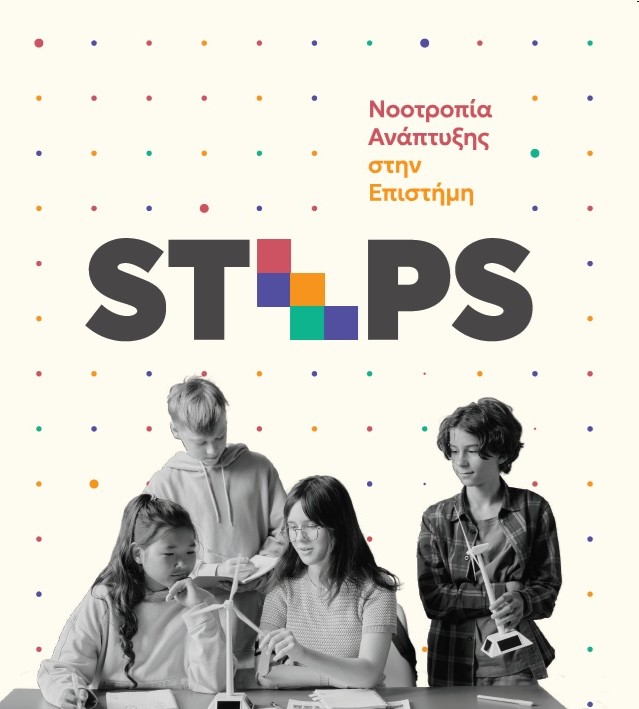
STEPS – Science for Growth: Empowering Minds
For STEPS, science is more than a source of knowledge. It is a powerful way of understanding the world, fostering curiosity, inspiring creativity, and empowering people to learn, explore, and shape the future.
At the heart of STEPS is the belief that knowledge and abilities can be developed through learning, purposeful effort, effective strategies, feedback, and reflection. The project embraces a Growth Mindset as a guiding approach across its activities, encouraging students, educators, researchers, and citizens to see challenges as opportunities to learn and grow.
In STEPS, mistakes are not viewed as failures, but as valuable parts of the learning and scientific discovery process. By fostering curiosity, perseverance, and confidence, STEPS encourages people of all ages to keep exploring, asking questions, and discovering new possibilities.
Inquiry-Based and Interdisciplinary Learning
STEPS embraces inquiry-based learning and an interdisciplinary STEAM approach, creating hands-on learning experiences that connect scientific knowledge with creativity, technology, problem-solving, and contemporary societal challenges.
Through STEAM, STEPS encourages participants to explore questions, experiment, collaborate across disciplines, and apply their knowledge to real-world challenges.
At the heart of STEPS are six commitments that shape how we engage with science, learning, and society.
Science & Society
Raise awareness of research and researchers’ role in society through interactive public events and school- based activities.
Fostering Critical Thinking
Foster curiosity, critical thinking, and STEM/STEAM interest via hands-on learning, accessible communication, and direct engagement with researchers.
Experiential Learning
Embed Growth Mindset principles into school culture so that strategic effort, persistence, reflection, and learning from mistakes are recognised as central to success.
Active Researcher Engagement
STEPS encourages researchers to actively engage with the public by sharing their work, knowledge, and experiences in accessible and engaging ways, helping to bring research closer to society.
Inclusion & Equality
Promote gender balance and inclusivity, ensuring access for underrepresented and remote communities through both physical and digital delivery.
Societal Impact
STEPS highlights the value and societal impact of research, while raising awareness of how European funding for research and innovation contributes to addressing societal challenges and improving people’s lives.
For STEPS, science is more than knowledge. It is a way of asking questions, exploring, experimenting, rethinking, and discovering.
European Researchers’ Night
An open celebration of science where the public meets the people behind research and takes part in experiments, interactive workshops, demonstrations, and hands-on activities. Through direct interaction with researchers, visitors can explore scientific ideas, ask questions, and discover how research connects with everyday life.
An open celebration of science where the public meets the people behind research and takes part in experiments, interactive workshops, demonstrations, and hands-on activities. Through direct interaction with researchers, visitors can explore scientific ideas, ask questions, and discover how research connects with everyday life.
ΠερισσότεραResearchers at Schools
As part of the STEPS project , research comes into the school environment through direct encounters between researchers, pupils, and teachers . Through Learning Labs and inquiry-based activities , STEPS transforms the school into a space for scientific exploration and discovery, encouraging pupils to ask questions, experiment, and engage with research in an active and meaningful way.
As part of the STEPS project , research comes into the school environment through direct encounters between researchers, pupils, and teachers . Through Learning Labs and inquiry-based activities , STEPS transforms the school into a space for scientific exploration and discovery, encouraging pupils to ask questions, experiment, and engage with research in an active and meaningful way.
ΠερισσότεραSTEPS also invests in the professional development of researchers and educators through a specially designed training programme delivered by the Centre for Training and Lifelong Learning (KEDIVIM) of the University of Crete.
The training programme brings together Growth Mindset, inquiry-based learning, STEAM, and promote gender equality and inclusion with science communication, Learning Labs, and public engagement. It aims to equip researchers with the skills to transform scientific knowledge into accessible and engaging experiences, while supporting educators in creating learning environments that foster curiosity, collaboration, perseverance, and the active participation of all learners.